• Login
    • English
    • O‘zbekcha
    • Русский
Society, Gender and Family in Central Asia international academic peer reviewed journal
  • Homepage
  • Current
  • Archives
  • News
    • Demography
    • History
    • Makhalla and life
    • Scientific news and analysis
    • Pedagogy
    • Psychology
    • Family and society
    • Sociology
    • Management
    • Philosophy
    • About the Journal
    • Submissions
    • Editorial council
    • Editing board
    • Privacy Statement
    • Contact
  1. Home
  2. Search
Advanced filters

Search Results

Found 14 items.
Socio-political analysis of the formation of gender culture
Davronova Feruza Rakhmonovna

The article analyzes the issues of formation of gender culture in society and its influence on gender policy. The object of the study is analyzed from the position of socio-historical, structural and gender approaches. The article states that the formation and popularization of gender culture in society, on the one hand, has a positive impact on the gender policy of the state, and on the other hand, contributes to the transformation of gender relations in society, that is, it acquires an egalitarian character. Conclusions are made that a systematically implemented gender strategy influences public consciousness, replaces gender stereotypes with egalitarian social relations and contributes to ensuring equal opportunities for men and women in modern society

26-10-2025
  • PDF (O‘zbekcha)
11-15 95 29
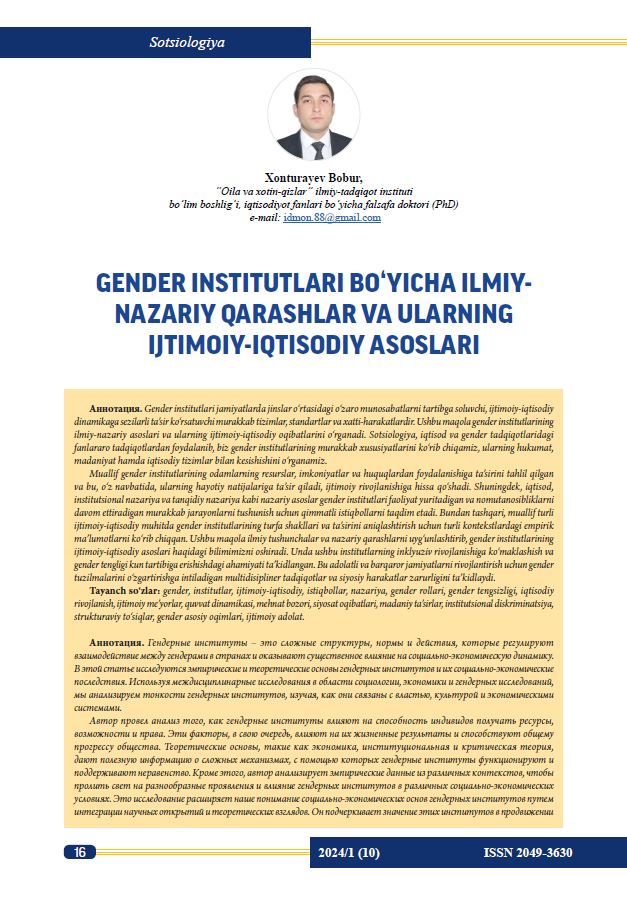
Scientific and theoretical views on gender institutions and their socio-economic foundations
Khonturaev Bobur

gender institutions are intricate frameworks, norms, and actions that govern the interactions between genders in countries and have a substantial influence on socio-economic dynamics. This article explores the empirical and theoretical underpinnings of gender institutions and their socio-economic ramifications. Utilizing interdisciplinary research from sociology, economics, and gender studies, we analyze the intricacies of gendered institutions, investigating how they connect with power, culture, and economic systems.
The author conducted an analysis of how gender institutions influence individuals’ ability to get resources, opportunities, and rights. These factors, in its turn, have an effect on their life outcomes and contribute to the overall progress of society. Theoretical frameworks such as economics, institutional theory, and critical theory provide useful insights into the intricate mechanisms by which gendered institutions function and sustain disparities. Furthermore, the author analyzes empirical data from various contexts to elucidate the diverse manifestations and impacts of gender institutions in distinct socio-economic settings. This research enhances our understanding of the socio-economic foundations of gender institutions by integrating scientific discoveries and theoretical views. It emphasizes the significance of these institutions in advancing inclusive development and accomplishing the gender equality goal. This emphasizes the need of doing interdisciplinary research and implementing policy measures that aim to reshape gender frameworks, with the goal of fostering equitable and environmentally responsible communities.

11-04-2025
  • PDF (O‘zbekcha)
16-24 215 30
The issue of gender equality in the Republic of Uzbekistan and the formation of gender culture in the family
Baydjonov Furkat Bakhramovich

The article analyzes the issue of gender equality in our country, the formation of gender culture in the family, as well as the factors that serve the implementation of modern methods of forming gender culture in the family.

25-08-2025
  • PDF (O‘zbekcha)
139-143 230 24
Socio-pedagogical foundations of the development of gender culture in the family
Baydjonov Furkat Bakhramovich

This article analyzes the socio-pedagogical aspects of the development of gender culture in the family, as well as the socio-pedagogical factors that create modern forms of gender culture. It is emphasized that it is necessary to form the culture of specific roles, relationships and behavior in cooperation with the family, neighborhood and educational institutions.

05-04-2023
  • PDF (O‘zbekcha)
73-76 12 18
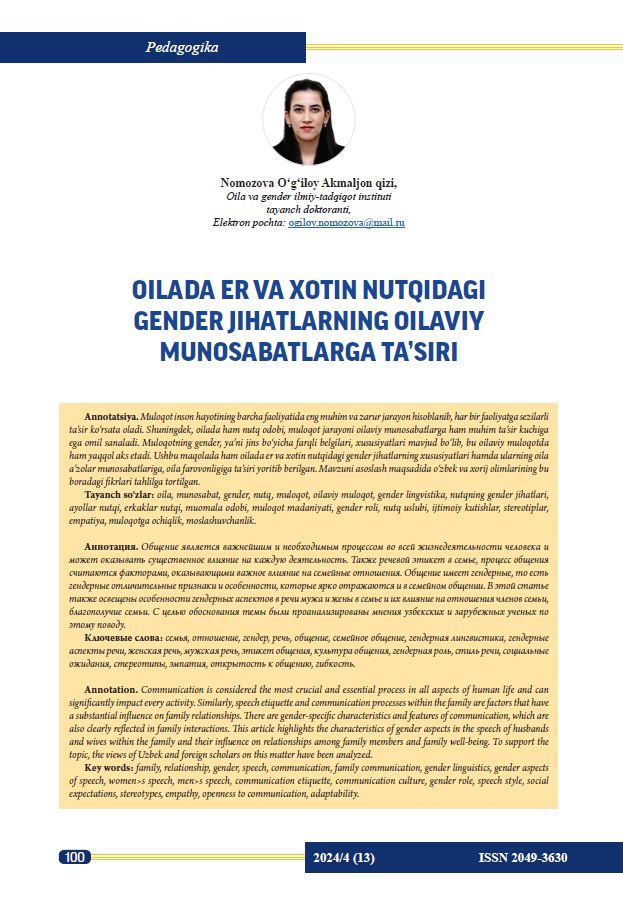
The impact of gender aspects in the speech of husbands and wives on family relationships
Nomozova Ugiloy Akmaljon kizi

Communication is considered the most crucial and essential process in all aspects of human life and can significantly impact every activity. Similarly, speech etiquette and communication processes within the family are factors that have a substantial influence on family relationships. There are gender-specific characteristics and features of communication, which are
also clearly reflected in family interactions. This article highlights the characteristics of gender aspects in the speech of husbands and wives within the family and their influence on relationships among family members and family well-being. To support the topic, the views of Uzbek and foreign scholars on this matter have been analyzed

03-04-2025
  • PDF (O‘zbekcha)
100-104 263 19
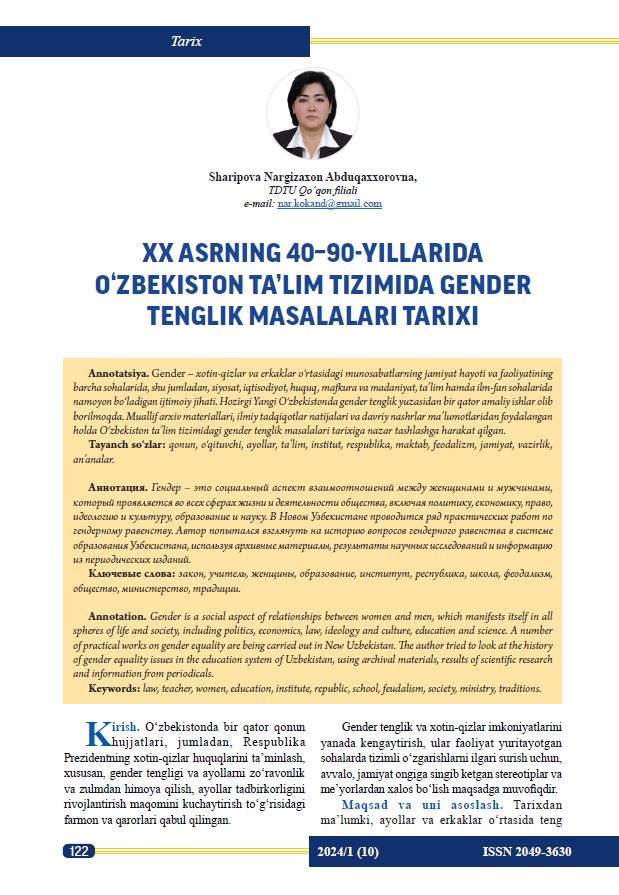
The history of gender equality issues in the education system of Uzbekistan in the 1940s–1990s.
Sharipova Nargizakhon Abdukakhorovna

Gender is a social aspect of relationships between women and men, which manifests itself in all spheres of life and society, including politics, economics, law, ideology and culture, education and science. A number of practical works on gender equality are being carried out in New Uzbekistan. The author tried to look at the history of gender equality issues in the education system of Uzbekistan, using archival materials, results of scientific research and information from periodicals

16-04-2025
  • PDF (O‘zbekcha)
122-126 184 36
Technologies for developing gender culture in high school students in family and general education schools
Bayjonov Furqat Bakhromovich

In this article, the technologies for the development of gender culture of high school students in cooperation with family and general education schools were considered.

10-06-2022
  • PDF (O‘zbekcha)
54-60 18 17
Women in Science: Limitations and New Opportunities
Karimova Dildora Mirsabitovna, Alimjonova Dilbar Magribjanova

Gender equality issues have become a priority for New Uzbekistan. The representation of women in the labor market, in science, business, and the political arena is increasingly beginning to influence the prestige of the republic in the global world. Human capital and women’s participation in research can become a driver of the country’s innovative development. The study of economic, social and cultural factors of women’s involvement in science allowed the authors to identify limitations and new opportunities for women’s active participation in scientific research.

28-03-2022
  • PDF (Русский)
4-9 14 19
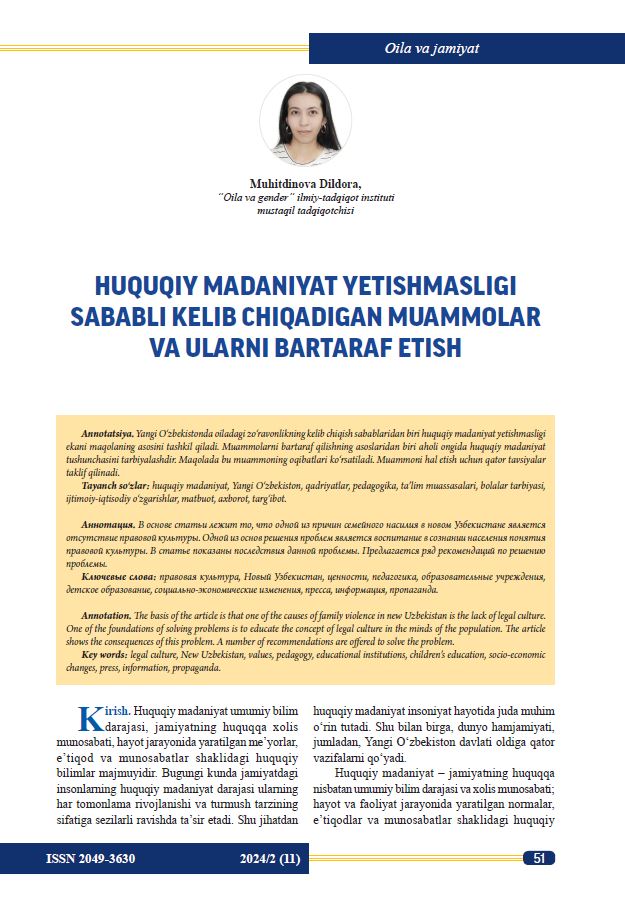
Problems arising from the lack of legal culture and their elimination
Mukhitdinova Dildora

The basis of the article is that one of the causes of family violence in new Uzbekistan is the lack of legal culture. One of the foundations of solving problems is to educate the concept of legal culture in the minds of the population. The article shows the consequences of this problem. A number of recommendations are offered to solve the problem

08-04-2025
  • PDF (O‘zbekcha)
51-55 175 19
Uzbekistan's strategy for supporting families and women (socio-philosophical approach)
Viktor Aleksandrovich Alimasov

This article reveals Uzbekistan’s ongoing reforms and strategic objectives in supporting the institution of family and providing assistance to women

01-07-2025
  • PDF (O‘zbekcha)
47-52 311 30
Criteria for a competency-based approach to the use of virtual world tools in the socialization of adolescents
Khatamov Boburjon Qosimjon ugli

The activities that a child engages in most during adolescence are the ones most likely to be engaged in as an adult. Formation of competences in the correct use of virtual world tools is an important task for our society today. These issues are studied and analyzed in this article

04-04-2025
  • PDF (O‘zbekcha)
26-31 121 19
The importance of family reconciliation principles based on national values
Toshmurodov Mirolim Ismoil ugli

This article analyzes the role of the principles of family harmony, formed on the basis of national values, in ensuring the stability of society and spiritual harmony. In it, the customs, traditions, and moral views of the Uzbek people, formed over centuries, are interpreted as a factor strengthening family harmony, mutual respect, tolerance, and patience. The article also
scientifically substantiates the need to preserve national values in the context of modern globalization, instill a culture of compromise in the minds of young people, and strengthen the spiritual immunity of the family. As a result, national values were assessed as the foundation of the principles of family harmony and a guarantee of social stability.

06-01-2026
  • PDF (O‘zbekcha)
19-24 5 2
A historical analysis of the impact of industrialization in Uzbekistan on family labor relations in the 20th century
Mamatkulov Bekzod Sherozovich

The industrialization of Uzbekistan in the 20th century brought profound transformations to the country’s socio-economic structure. This article provides a historical analysis of how industrial development influenced family labor relations. It examines the redistribution of labor between men and women, the changing economic roles within the family, and the impact of urbanization and social policy on domestic life. The study reveals that industrialization played a crucial role in shaping labor culture and gender roles in Uzbek society.

06-01-2026
  • PDF (O‘zbekcha)
71-76 3 3
Analysis of research findings aimed at encouraging reading among adolescents and the concept of reading
Khudoyberdiyeva Markhabo

The article explores adolescents’ perspectives on reading. It was found that peers and family members have a significant influence on adolescents’ reading habits. Based on the data obtained, practical recommendations were developed to promote the formation of a reading culture among adolescents

01-07-2025
  • PDF (O‘zbekcha)
42-46 68 30
1 - 14 of 14 items

Editorial council Editing board Requirements for articles Make a submission Quick submission of the material

Editorial council

Egamberdiyeva N.
Editor-in-Chief
Doctor of Pedagogical Sciences, Professor
Abduramanov K.
Deputy Chief Editor
Doctor of Economics, Professor
Mavlonov B.
Responsible Secretary
Doctor of Philosophy in Pedagogical Sciences (PhD)

Information

  • For Readers
  • For Authors
  • For Librarians

Current Issue

  • Atom logo
  • RSS2 logo
  • RSS1 logo
Society, Gender and Family in Central Asia international academic peer reviewed journal

Jurnal O‘zbekiston Respublikasi Vazirlar Mahkamasi huzuridagi Oliy attestatsiya komissiyasining dissertatsiyalar asosiy ilmiy natijalarini chop etish tavsiya etilgan ilmiy nashrlar RO‘YXATI (2019)ga pedagogika, psixologiya, tarix va falsafa fanlari bo‘yicha doktorlik dissertatsiyalari himoyasi uchun ilmiy maqolalar e’lon qilinishi mumkin bo‘lgan jurnal sifatida ro‘yxatga olingan.

NAVIGATION:
About Current Archives Contact

CONTACT:

+998 (90) 356-01-56


+998 (99) 302-27-55


interjournal@moiti.uz


25 Chilonzor str., Chilonzor dist., Tashkent city 100000.

 
© 2026 Society, Gender and Family in Central Asia international academic peer reviewed journal
Developed by in Science | Site create by in Designer